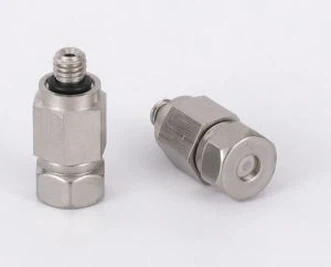
There are four principles of sprayer spraying:
The first one uses Bernoulli's principle.
Bernoulli's principle says that in the same fluid, the flow rate is large, but the pressure is small; the flow rate is small, and the pressure is strong. The fluid will automatically flow from high pressure to low pressure. When passing through the trigeminal pipe, the low-speed flowing water flows to the high-speed flowing air. The water is torn into droplets by the high-speed air (Imagine that the water flowing out of the faucet has a slow speed at first, which is a water column; but then the speed gradually increases and then becomes drop by drop). These small water droplets become fog after spraying out.
The second method uses the principle of pressing water into a thin tube to cause high-speed water flow, and the high-speed water flow breaks into small water droplets when it hits an obstacle.
The situation is like opening the faucet and blocking it with your fingers. Household sprayers use this structure because of the low cost.
The third is to charge water (water is a dielectric), and use the same kind of charge to repel each other to divide the water into droplets.
The droplets of this method are very small. The same principle is used to paint cars.
The fourth is the principle of ultrasonic atomization.
Vibration can cause "sprays" on the water surface. The vibration frequency of ultrasonic waves is very high, so the wavelength of its "waves" is very small, so its "sprays"—small water droplets are also very small, and these small water droplets become fog.
.
Backpack:
1. Working principle
When the operator pushes the rocker or handle up and down, the plug rod reciprocates up and down in the pump barrel through the connecting rod, with a stroke of 40-100 mm. When the stopper rod moves up, the cup moves from bottom to top, and the volume of the cavity formed by the cup and the pump barrel under the cup continues to increase, forming a partial vacuum. At this time, the liquid in the liquid barrel rushes through the water inlet valve under the action of the pressure difference between the liquid surface and the cavity, and enters the pump barrel along the water inlet pipe to complete the water absorption process. When the plug rod descends, the cup moves from top to bottom, and the liquid in the pump barrel is squeezed, causing the hydraulic pressure to increase suddenly. Under the action of this pressure, the inlet valve is closed, the outlet valve is pressed open, and the liquid enters the air chamber through the outlet valve. The air in the air chamber is compressed to generate pressure on the liquid. After the switch is turned on, the liquid enters the nozzle through the spray rod and is atomized and sprayed out. In the hollow cone mist spray nozzle, including the tangential liquid inlet nozzle or the nozzle with the swirling water core, the liquid enters the swirl chamber from the tangential liquid inlet channel or from the spiral channel of the swirling blade and the swirling water core. When rotating, the nozzle hole is on the axis of the vortex chamber, so the sprayed liquid forms a hollow conical film, which is then crushed into droplets. As for the sprinkler head with a double-groove water swirl core, the liquid passes through the water core from the axial inlet channel on the water swirl core, and then enters the vortex chamber tangentially composed of the pit in the front center of the water swirl core and the nozzle sheet. The nozzle of the slit nozzle has a cylindrical flow end in a semi-spherical shape, and a V-shaped notch is opened on the outside. The two liquid streams ejected from the arc surfaces on both sides of the V-shaped groove collide with each other to produce liquid in the direction of the groove. Membrane, liquid film and static air media act to form fan-shaped mist flow.
Two, use and maintenance
In addition to the use and maintenance of the knapsack sprayer in strict accordance with the requirements of the product instruction manual, the following points should also be paid attention to.
① The new cowhide bowl on the Gongnong-16 sprayer should be immersed in machine oil or animal oil (vegetable oil is not allowed) for 24 hours before installation. When installing the plug rod assembly into the pump barrel, pay attention to placing one side of the cowhide bowl in the pump barrel obliquely, and then rotate it to make the plug rod vertical, and use the other hand to help press the edge of the cup into the pump barrel. It can be loaded smoothly, avoiding forcibly stuffing.
② Choose suitable spray rods and nozzles according to needs. The NS-15 sprayer has several types of spray bars. The double nozzle T-shaped spray bar and the four-nozzle direct spray bar are suitable for wide-area spraying. The U-shaped double nozzle spray bar can be used for spraying on the crop line. Suitable for spraying on both sides of the crop base between rows. Hollow cone mist nozzles have nozzle pieces with several apertures. Large holes have a large flow rate. The fog spray bar is suitable for wide-spreading and all-round spraying, the U-shaped double nozzle spray bar can be used for spraying on the crop row, and the side double spray nozzle spray bar is suitable for spraying on both sides of the crop base between rows. Hollow cone mist nozzles have nozzle pieces with several apertures. Large holes have a large flow rate. The droplets are thicker and the spray angle is larger; the opposite of the small holes, the flow is small, the droplets are finer, and the spray angle is small. It can be selected appropriately according to the requirements of the spraying operation and the size of the crop.
③ When installing a 110° slit nozzle on the T-shaped direct spray rod of the NS-15 sprayer, the notch on the nozzle should be slightly deflected to form an angle of about 5° with the axis of the nozzle, so as to make the mist flow of the adjacent nozzles. Do not collide with each other. Attention should be paid to the height of the spray rods during operation, so that the mist flow of each nozzle overlaps each other, and the amount of mist is evenly distributed in the entire spray range, which is suitable for full spraying of herbicides.
④ When carrying the work, press the joystick 18-25 times per minute. When operating Gongnong-16 and Changjiang-10 sprayers, do not bend too much to prevent the liquid from spilling on the body from the lid.
⑤ Fill the liquid without exceeding the water level shown on the wall of the barrel. If you fill too much, there will be leakage at the cover of the pump barrel during work. When the liquid in the air chamber exceeds the safe water level, stop pumping air immediately to prevent the air chamber from exploding.
⑥ All leather gaskets should be soaked in engine oil during storage to avoid shrinkage and hardening.
⑦ At the end of daily use, a little water should be sprayed, and all parts of the sprayer should be cleaned, and then placed in a ventilated and dry indoor place.
⑧ After spraying the herbicide, the sprayer, including the liquid tank, hose, spray rod, nozzle, etc. must be thoroughly cleaned, so as not to cause damage to the crops during the next spraying.