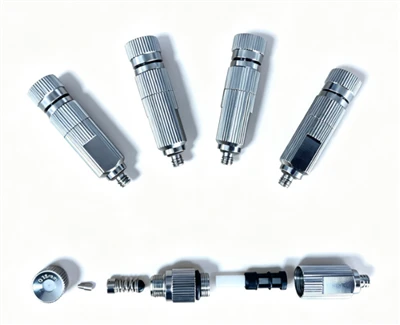
What is the development of the atomizing nozzle technology of China nozzle net?
Atomization technology covers almost all industrial fields, such as transportation, agricultural production, and people's daily life. In addition to the combustion of various fuels (gas, liquid and solid fuel), atomization technology in non-combustion industries such as catalytic production Granules, food processing, powder coating, and pesticide spraying are also widely used. It is mainly a brief introduction to the atomization technology of liquid fuel.
Liquid atomization mechanism theory
The so-called atomization of liquid refers to the physical process of liquid becoming a liquid mist or other small droplets in a gaseous environment under the action of external energy. For its atomization mechanism, there have been many explanations, such as aerodynamic interference, pressure oscillation, turbulence disturbance, air disturbance, boundary condition mutation, etc., which are briefly introduced as follows:
1. Aerodynamic interference
Castleman first proposed aerodynamic interference, he believes that due to the aerodynamic interference between the jet and the surrounding gas, the surface of the jet is unstable. As the speed increases, the surface length of the unstable wave is shorter and shorter, up to the order of micrometers, and the jet is dispersed into a mist.
2. Pressure oscillation says
The pressure oscillation is said to observe that the pressure oscillation of the liquid supply system has a certain influence on the atomization process. Thus, pressure oscillations are prevalent in general injection systems and are therefore considered to play an important role in atomization.
3. Turbulence disturbance
The turbulent disturbance says that the jet atomization process takes place inside the nozzle, and the turbulence of the fluid itself may play an important role. It has also been suggested that the radial velocity of the fluid in the nozzle as a turbulent tube flow will immediately cause disturbance at the nozzle outlet, thereby generating atomization.
Air disturbance
The air disturbance said that it has the opposite attitude to the turbulence disturbance, and believes that the large amplitude pressure disturbance generated by the cavitation phenomenon in the fuel injection system is the cause of atomization.
5. Boundary condition mutation
The boundary condition mutation says that the boundary condition (internal stress) of the liquid is abrupt at the nozzle exit; or the laminar jet protrudes and loses the nozzle wall surface constraint, causing the velocity distribution in the section to suddenly change and atomization.
ADD:No.462, Zhongyang Rd., Diankou Town, Zhuji City, Zhejiang Province, China
Phone: 13735217187
Tel: + 86-0575-87061046
Fax: + 86-0575-87555003
E-mail: info@hmisting.com
E-mail:wed@hmisting.com
Phone: 13735217187