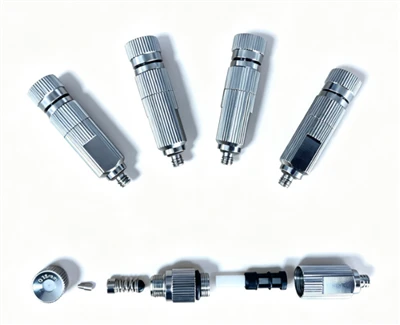
We know that there are many kinds of atomizing nozzles, but what are the advantages of various atomizing nozzles? What are the disadvantages?
1. Pressure atomizing nozzle
When the high-pressure liquid is injected into the air from the nozzle at high speed, due to the difference in the structure of the nozzle, the corresponding atomization process is also different. Breaking from the continuous phase into droplets is called primary breakup. If the liquid velocity is large enough, the subsequent secondary crushing phenomenon can continue to occur, and the atomization effect is more obvious. Generally, the size can be used to judge the turbulence of the liquid flow and the degree of atomization.
2. Centrifugal jet atomizing nozzle
The centrifugal nozzle has a swirl chamber structure inside, and the fluid forms a liquid mold with a small thickness inside the nozzle. After spraying out of the nozzle, the surface tension of the liquid overcomes the inertial force and is broken into droplets under the action of aerodynamic force. Large, the injection speed increases, the liquid film breaks into filaments or ribbons, and the relative movement with the air intensifies, and it can even be atomized when it leaves the nozzle. For this type of nozzle, the atomization mechanism includes centrifugal atomization and speed atomization. Interaction, in which the design of the swirl chamber is the key to determine the atomization performance. This type of nozzle has the advantage of sufficient atomization, but the disadvantages are also obvious. The spray speed is not high, and most of the spray profiles are hollow cone angles.
3. Medium atomizing nozzle
The method of atomizing the liquid by means of the same axial or vertical high-speed jet of fluid such as air or inert gas can be called a two-fluid atomizing nozzle. (Gas nozzle), using the impact and friction of the high-speed airflow and the liquid column or liquid film of the low-speed liquid to break into fine droplets. This type of nozzle has the advantages of uniform and sufficient atomization.
4. The liquid of the impact atomizing nozzle is ejected from the nozzle at high speed, and collides with the solid (disk, thimble, etc.) Good, but less uniform droplet diameter distribution and generally low spray velocities.
5. Ultrasonic atomization and electrostatic atomization nozzles Ultrasonic atomization and electrostatic atomization nozzles are generally used in laboratories and medical equipment and other places. Although the atomization effect is very good, due to the small amount of liquid atomization and high cost, There are not many industrial applications. To sum up, all kinds of traditional atomizing nozzles have obvious advantages and disadvantages, and different application occasions have different requirements for nozzle atomization performance.