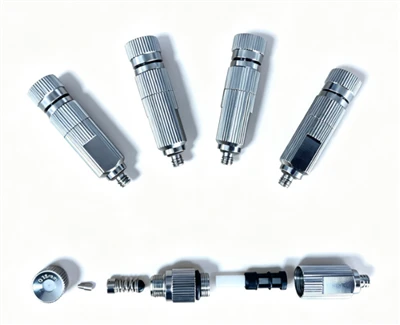
There are many types of atomizing nozzles. How many types can be divided according to the atomization method?
(1) Mechanical atomization
Mechanical atomization mainly relies on the high-speed jet generated by the liquid under the pressure difference to atomize itself, so it can be divided into direct nozzle, centrifugal nozzle and rotary nozzle.
Direct atomization and centrifugal atomization can be collectively referred to as pressure atomization. The direct nozzle mainly relies on water spray to achieve atomization. The water pressure requirement is relatively high, and the larger the diameter of the spray hole, the coarser the atomization. Therefore, the diameter of the spray hole cannot be too large, and the flow adjustment range is relatively small. The centrifugal nozzle uses the centrifugal force generated by the high-pressure water through the swirl device to generate the liquid film, which is broken by the air and atomized. The effect of centrifugal atomization is better than that of direct atomization, but it also needs higher water supply pressure, so the application conditions are limited.
Rotary nozzles are generally divided into two types: rotary type and rotary nozzle type. The rotating type is divided into the rotating cup type and the rotating disk type. The rotating cup atomization is to spray water into the front end of the conical rotating cup, spread the water into a thin film with the help of the rotating cup at high speed, and atomize the liquid by the combined action of "centrifugal force spray" and "speed spray". Similarly, the disc atomization relies on the high-speed rotating disc to atomize the liquid.
(2) Medium atomization
According to the different atomization methods, it can be divided into pneumatic atomization and bubble atomization. Pneumatic atomization nozzles are widely used.
The pneumatic atomizing nozzle relies on a certain pressure of gas (compressed air or steam) to form a high-speed air flow, so that a high relative velocity between air and water can be formed to achieve the atomization purpose. Its advantage is that good atomization effect can be obtained under low water pressure, and the working condition can be adjusted in a large range. However, the power source is not single and the system composition is complex.
(3) Special nozzle atomization
Special nozzles generally use ultrasonic, electromagnetic field, electrostatic effect and other principles to atomize. Although this kind of nozzle has good effect in some other industrial applications, it is seldom used due to the bad underground environment in coal mines.