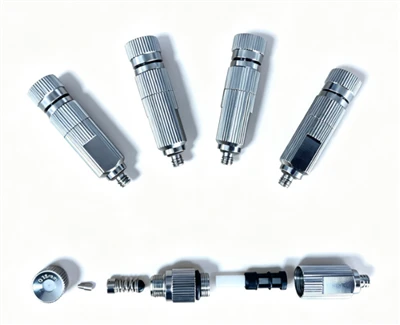
Nozzles can produce mist when a liquid is forced through a small opening at high pressure. The liquid breaks up into tiny droplets, forming a fine mist that can be dispersed over a large area.
There are different types of nozzles that can produce mist, including ultrasonic nozzles, high-pressure nozzles, and centrifugal atomizers. Ultrasonic nozzles use high-frequency vibrations to break up the liquid, while high-pressure nozzles use a combination of high pressure and turbulence to create mist.
Mist is commonly used in many applications such as cooling, humidifying, and dust suppression. As mist droplets are very small, they can quickly evaporate and cool the surrounding air. This is why mist is often used in outdoor areas, such as patios or events, to provide relief from the heat.
Mist can also be used in industrial settings to control dust and airborne particles. By creating a fine mist, the airborne particles can be captured and settled, reducing the amount of dust in the air.
In summary, nozzles produce mist by forcing liquids through a small opening at high pressure, creating tiny droplets that form a fine mist. Mist can be used for a variety of applications, from cooling and humidifying to dust suppression in industrial settings.